
 info@gbtest.cn


 en
en ru
ru es
es ar
ar

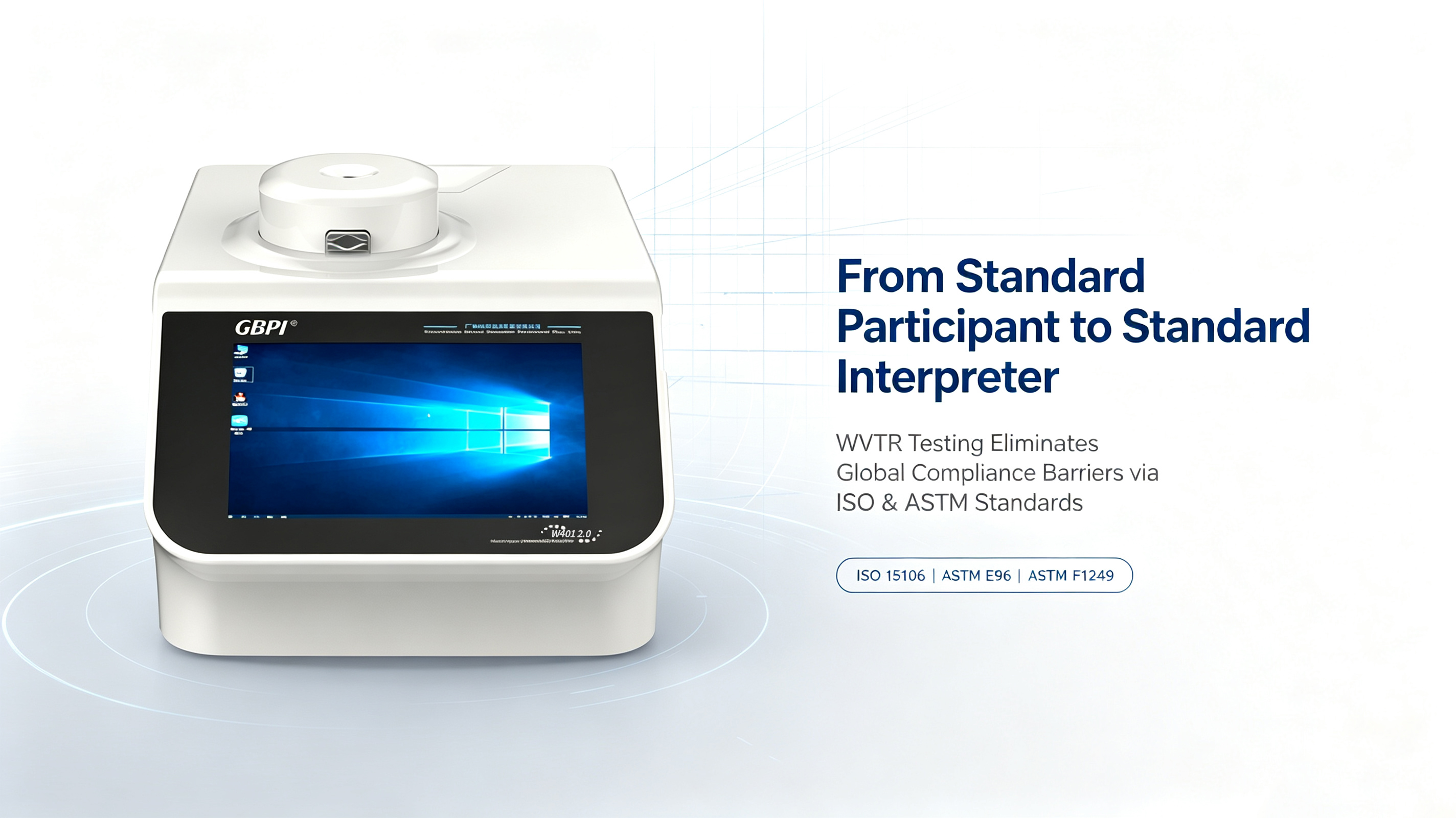
From Standard Participant to Standard Interpreter: WVTR Testing Eliminates Global Compliance Barriers via ISO & ASTM Standards
Address: No.3 Linjiang Road, Xiagang Subdistrict, Huangpu District, Guangzhou
Tel: +86 15820231129 | Official Website: www.gbpitester.com
Introduction
Many packaging testing equipment manufacturers take pride in stating they have participated in national or international standard formulation working groups. Yet a critical industry gap remains: mere “standard participation rights” rarely turn into actionable guidance for global manufacturers. Most brands only print “compliant with ISO and ASTM” on product brochures without explaining the gaps between these two core WVTR (Water Vapor Transmission Rate) standards. This leaves packaging producers exporting to Europe, North America and Southeast Asia trapped in compliance confusion, audit delays and costly product retests.
As a core participant in multiple domestic packaging standards and a deep researcher of ISO 15106 and ASTM series international test specifications, GBPI has repositioned itself from a passive standard participant to a professional standard interpreter. This article follows a clear logic: international standard differences → global customer compliance anxiety → in-depth test method decoding → targeted instrument configuration advice, helping packaging enterprises resolve cross-border certification troubles once and for all.
1. Core Differences Between ISO and ASTM WVTR Standards
WVTR acts as the decisive indicator to judge moisture barrier performance of pharmaceutical blister foil, food composite film and new energy battery separators. However, ISO 15106 and ASTM E96 / ASTM F1249 adopt completely different testing frameworks, whose data results cannot be mutually recognized by global auditors.
First lies the test principle gap. ISO 15106-2 regards the infrared sensor method as the arbitration testing method. It applies stable nitrogen carrier gas under equal pressure to capture tiny water vapor concentration changes, delivering continuous, repeatable data. By contrast, ASTM E96 relies on the gravimetric cup method. Operators need to weigh desiccant-filled cups manually over days to calculate permeability. ASTM F1249’s infrared scheme also sets stricter temperature-humidity tolerance ranges than ISO, creating measurable deviations on high-barrier PVD and aluminum foil materials.
Second are unified specifications and unit rules. ISO unifies a fixed 50.24 cm test area and mandatory metric unit output (g/m²·24h). ASTM allows flexible sample sizes and supports both imperial and metric units without unified error correction formulas. Many third-party regulatory auditors reject reports using only one standard due to inconsistent calibration rules.
Third covers regional application boundaries. ISO standards are universally accepted in EU, ASEAN, China and most global pharmaceutical ICH stability tests. ASTM norms are compulsory for US FDA, Canadian food safety and Latin American import filings. A batch of packaging materials tested under only one standard will fail cross-continental certification, forcing redundant sample testing and delayed product launches. Most instrument suppliers never elaborate on these distinctions, leaving clients facing unresolvable audit risks.
2. Universal Compliance Anxiety of Global Packaging Enterprises
Uncoordinated ISO and ASTM rules bring three costly troubles to manufacturers worldwide, which precisely reflects the flaw that standard participation fails to translate into customer value.
The first risk is cross-border audit failure and product recall. Statistics show over 70% Southeast Asian packaging recall incidents originate from unrecognized WVTR test data. Pharma exporters using ISO-only reports frequently receive FDA non-compliance notices; food brands with ASTM test files cannot finish EU food contact material registration. Repeated audits waste labor and block overseas sales channels.
The second hidden cost comes from duplicate testing. Factories without dual-standard testing equipment must outsource samples to third-party labs twice separately for ISO and ASTM tests. Extra sample consumption, outsourcing fees and waiting cycles extend R&D progress by 2 to 4 weeks on average, compressing product market window.
Third is material formula misjudgment. R&D teams relying on single-standard data will misjudge material moisture resistance. Ultra-high-barrier battery separators show misleading high permeability under ASTM E96 gravimetric tests, while ISO infrared data delivers accurate long-term storage performance judgment. Wrong material selection leads to mass finished product deterioration and huge economic losses.
All these pains stem from an industry loophole: many brands join standard drafting meetings but cannot translate standard texts into practical operational guidance for end users. GBPI’s shift to a “standard interpreter” fills this blank.
3. Professional Decoding of Two Mainstream WVTR Test Methods
ISO 15106-2 Infrared Method (Global Arbitration Standard)
This is the internationally recognized authoritative test scheme for high-barrier materials. It runs in fully closed constant temperature and humidity chambers, automatically collects vapor signals without manual intervention. Its strengths include ultra-high precision for low-permeability films, excellent data repeatability and official report templates accepted by EU and Asian regulatory bodies. It perfectly matches pharmaceutical blister materials, EVOH high-barrier films and lithium battery separator testing demands.
ASTM E96 Gravimetric Cup Method (North America Basic Standard)
Suitable for medium and low barrier rigid sheets and thick packaging materials. Its advantage lies in lower equipment investment. But obvious weaknesses exist: long testing cycles ranging from 24 to 72 hours, manual weighing brings systematic errors, and it cannot meet the precision requirements of new energy ultra-high barrier materials.
ASTM F1249 Infrared Method (US High-precision Supplementary Norm)
Adopts infrared detection consistent with ISO’s core logic but with different environmental control thresholds. It serves US pharmaceutical and food enterprises pursuing high repeatability and automated testing.
4. Targeted Instrument Configuration Suggestions for Different Clients
Based on standard interpretation results, GBPI provides differentiated equipment matching schemes to help customers cover dual-standard testing without redundant investment.
• Global export pharmaceutical / new energy manufacturers (EU + US market): Deploy dual-mode WVTR testers supporting both ISO 15106 and ASTM F1249 infrared methods. One device meets dual-region audit requirements, eliminates repeated testing and shortens R&D cycles.
• Food factories mainly selling to North America: Select standalone ASTM E96 gravimetric testing equipment for daily conventional medium-barrier film detection, matched with a small infrared tester for high-barrier new material R&D.
• Third-party comprehensive testing labs: Equip full set of dual-standard instruments covering gravimetric and infrared solutions, to satisfy all client certification demands from Europe and America.
• Small domestic manufacturers focusing on ASEAN markets: Choose ISO-compliant infrared WVTR equipment to match local regulatory filing rules and control procurement costs.
Conclusion
Participating in standard meetings only grants enterprises a seat at the table, while interpreting standards for clients creates real competitive advantages. The core competitive edge of GBPI is not merely its participation in standard compilation, but the capability to translate complicated ISO/ASTM clauses into clear testing solutions for global packaging manufacturers. By sorting out standard differences, eliminating compliance anxiety, decoding testing technologies and offering targeted instrument plans, we help every client turn complex international regulatory requirements into controllable, low-cost quality control workflows, and smoothly expand global business without certification obstacles.
Get Custom WVTR Test Solution & QuotationGBPI Packaging Test Equipment Manufacturer
Address: No.3 Linjiang Road, Xiagang Subdistrict, Huangpu District, Guangzhou, Guangdong, China
Tel: +86 15820231129 | Official Website: www.gbpitester.com